Service 08
Pressure Tank Repair & Replacement
Testing pre-charge, replacing failed bladders and sizing a new tank so the pump stops short-cycling.
The short answer
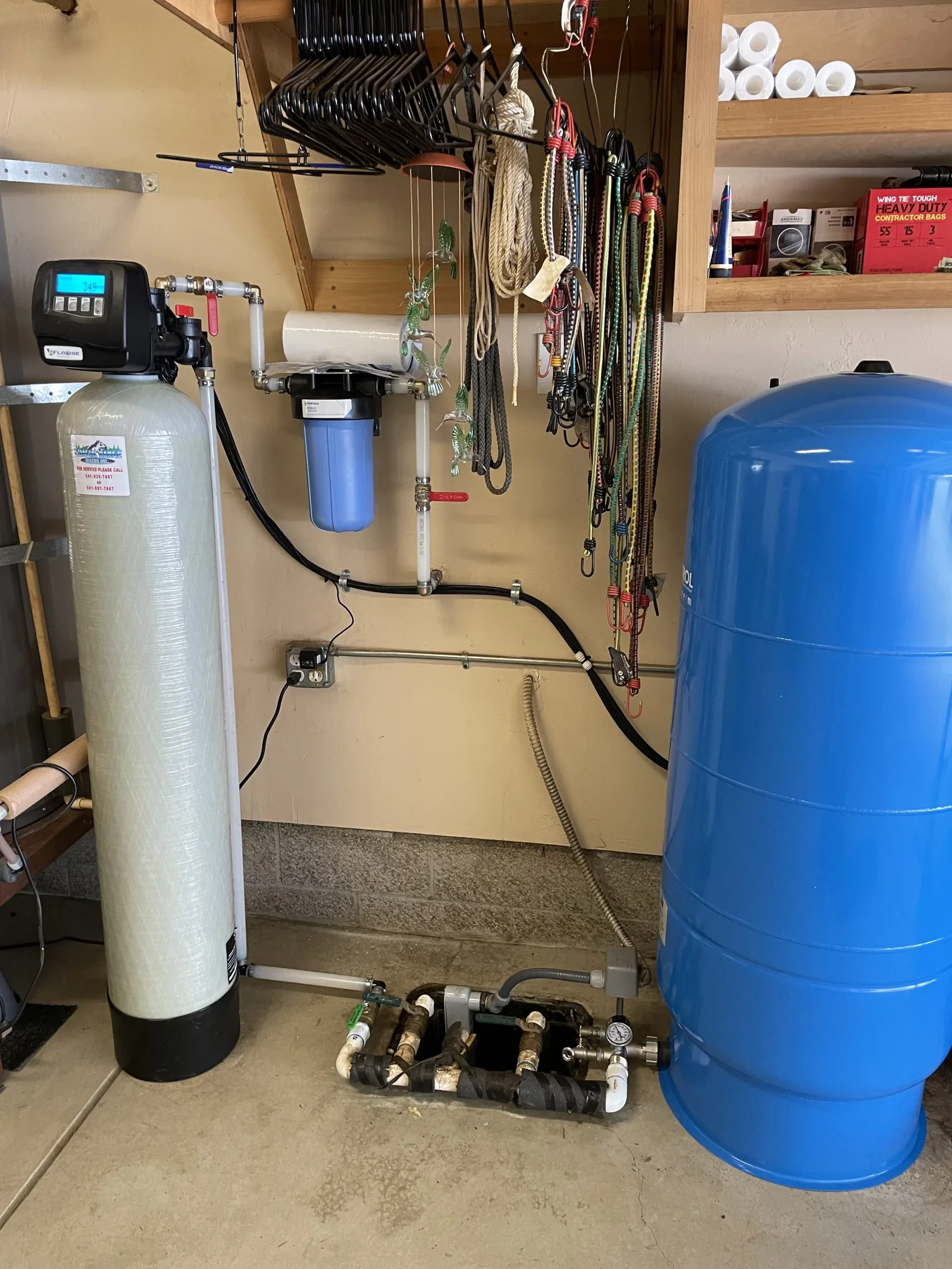
A pressure tank holds a cushion of compressed air that lets the pump run in longer, gentler cycles instead of switching on every time a tap opens. When the bladder fails or the air charge leaks away, the tank fills with water, the pump short-cycles, and the motor overheats. Testing the pre-charge takes a minute; replacing a failed tank is far cheaper than replacing the pump it destroys.
What usually causes it
Short cycling — the pump kicks on constantly
The pump runs for a few seconds, stops, runs again. This is the signature of a waterlogged tank. Every cycle puts a hard start on the motor, and motors have a finite number of those.
Water coming out of the air valve
If you press the Schrader valve on top of the tank and water comes out instead of air, the bladder has ruptured. There is no repair for that — the tank needs replacing.
A tank that is too small for the system
Some installations were sized for a small household and now serve a bigger one, or a constant-pressure pump was added without resizing the tank. The result is the same short cycling, just for a different reason.
Signs it is time to call
Any one of these is worth a phone call. Two or more together usually means something is already failing.
- Pump starts and stops rapidly during normal use
- Pressure gauge swings wildly
- Water instead of air from the tank valve
- Tank feels heavy or full when tapped
- Pump runs briefly every time a tap opens
- Visible rust or leaking at the tank base
- Banging or knocking when the pump starts
How a bladder tank is supposed to work
Inside the tank is a rubber bladder. On one side is water; on the other is compressed air, pre-charged to about two psi below the pump cut-in pressure. As water enters, it compresses the air, storing energy. When a tap opens, that stored energy pushes water out before the pump has to start.
When the bladder fails, water fills the whole tank and there is no air cushion left. The pump then has to start almost immediately every time water is used. That is short cycling, and it is hard on the motor, the switch and the check valve.
Recharge or replace
If the bladder is intact and the tank simply lost air, recharging it restores normal operation. We drain the tank, set the pre-charge with a gauge, and check that it holds. If the charge will not hold, or water comes out of the valve, the bladder has failed and the tank must be replaced.
When replacing, we size the tank to the flow rate of the pump so the pump runs for at least a minute per cycle. A bigger tank is not automatically better — it has to match the pump.
The right pre-charge
For a 30/50 switch, the tank is charged to about 28 psi. For a 40/60 switch, about 38 psi. Charged too high, the tank gives little cushion; too low, and the pump short-cycles near cut-in. It is a two-minute check that most homeowners have never had done.
How the job runs
-
01
Test
Measure the pre-charge, watch the gauge through a cycle, and confirm whether the bladder holds air.
-
02
Recharge
If the bladder is sound, drain and set the correct pre-charge for your switch setting.
-
03
Replace if needed
New tank sized to the pump flow, new fittings and a check that the switch matches.
-
04
Verify
Run a full cycle and confirm the pump now runs in long, even cycles.
What you get
- A one-minute pre-charge test that prevents most pump burnouts
- Correct tank sizing for the pump, not just a like-for-like swap
- Switch settings checked at the same time
- Old tank removed and disposed of
How do I know if my pressure tank is failing?
Three signs: the pump short-cycles during normal water use, the pressure gauge swings rapidly, and water rather than air comes out when you press the valve on top of the tank. A tank that feels heavy or sounds full when tapped is waterlogged.
Can a pressure tank be repaired?
If it has only lost its air charge and the bladder is intact, yes — recharging restores it. If the bladder has ruptured, the tank cannot be repaired and must be replaced. There is no way to replace a bladder in a standard residential tank economically.
How long does a pressure tank last?
Ten to fifteen years is typical for a quality bladder tank. Tanks on wells with high sediment or aggressive water can fail sooner. A tank that is rusting at the base or has a bulging shell should be replaced before it leaks.
What size pressure tank do I need?
It depends on the pump flow rate and the switch settings. The rule of thumb is enough drawdown for the pump to run at least one minute per cycle. A tank that is too small causes short cycling even when it is working correctly.
Can I replace a pressure tank myself?
It is plumbing and electrical work under pressure, and a mistake can flood a well house or damage the pump. It is not a job we recommend for a homeowner, particularly where the switch and wiring have to be reconnected.
Related services
Low water pressure
Tracking down whether the pressure loss is the tank, the switch, a clogged filter, the pump, or the well itself.
Read moreWell pump repair
Diagnosis and repair for submersible, jet and booster pumps that have stopped, slowed down or started short-cycling.
Read moreWell pump maintenance
A scheduled look at the pressure tank, switch, controls and water quality before something fails on a Sunday.
Read morePressure tank repair across the service area
This service is available throughout Lane, Linn, Benton and Douglas counties. These pages cover the towns we are called to most.
Talk to a well tech
Not sure whether it is the pump, the tank or the well?
That is what the phone is for. Describe what the water is doing and we will tell you what it sounds like.
Request service
Book pressure tank repair
Send the details and we will call back with a time. If the water is off now, call 541-935-7867 instead.
Phone
Based in
22071 Fisk Rd
Noti, OR 97461
Emergency
No water, a burst line or a pump that will not stop: call any hour, including weekends.