Service 13
Well Water Purification
UV sterilisation, arsenic and nitrate treatment for wells where filtration alone is not enough.
The short answer
Well water purification addresses contaminants that affect health rather than appearance: bacteria, nitrate, arsenic and other dissolved elements. These are not solved by a standard sediment or carbon filter. Each needs a specific treatment — UV sterilisation for bacteria, anion exchange or reverse osmosis for nitrate, and adsorptive media or reverse osmosis for arsenic — chosen from a laboratory test.
What usually causes it
A positive bacteria test
Total coliform or E. coli in a private well usually points to a pathway from the surface: a failing well cap, a cracked casing, a compromised grout seal, or a recent flood. Disinfection treats the symptom; the entry point has to be fixed as well.
Nitrate from agriculture or septic systems
Nitrate is common in shallow groundwater under farm ground and near older septic systems. It is invisible and tasteless, and it is a particular concern for infants. Boiling does not remove it — it concentrates it.
Arsenic in volcanic and basin groundwater
Parts of Oregon have naturally elevated arsenic. It has no taste or smell, so only a lab test finds it. Treatment is specific and should be designed around the measured level.
Signs it is time to call
Any one of these is worth a phone call. Two or more together usually means something is already failing.
- Bacteria detected on a water test
- Recurring gastrointestinal illness in the household
- Nitrate above the safe limit on a lab report
- Arsenic detected on a lab report
- Water that tests clean but tastes "off"
- A well near livestock, farm ground or a septic system
- A well that flooded or was recently repaired
Treat the source, then the water
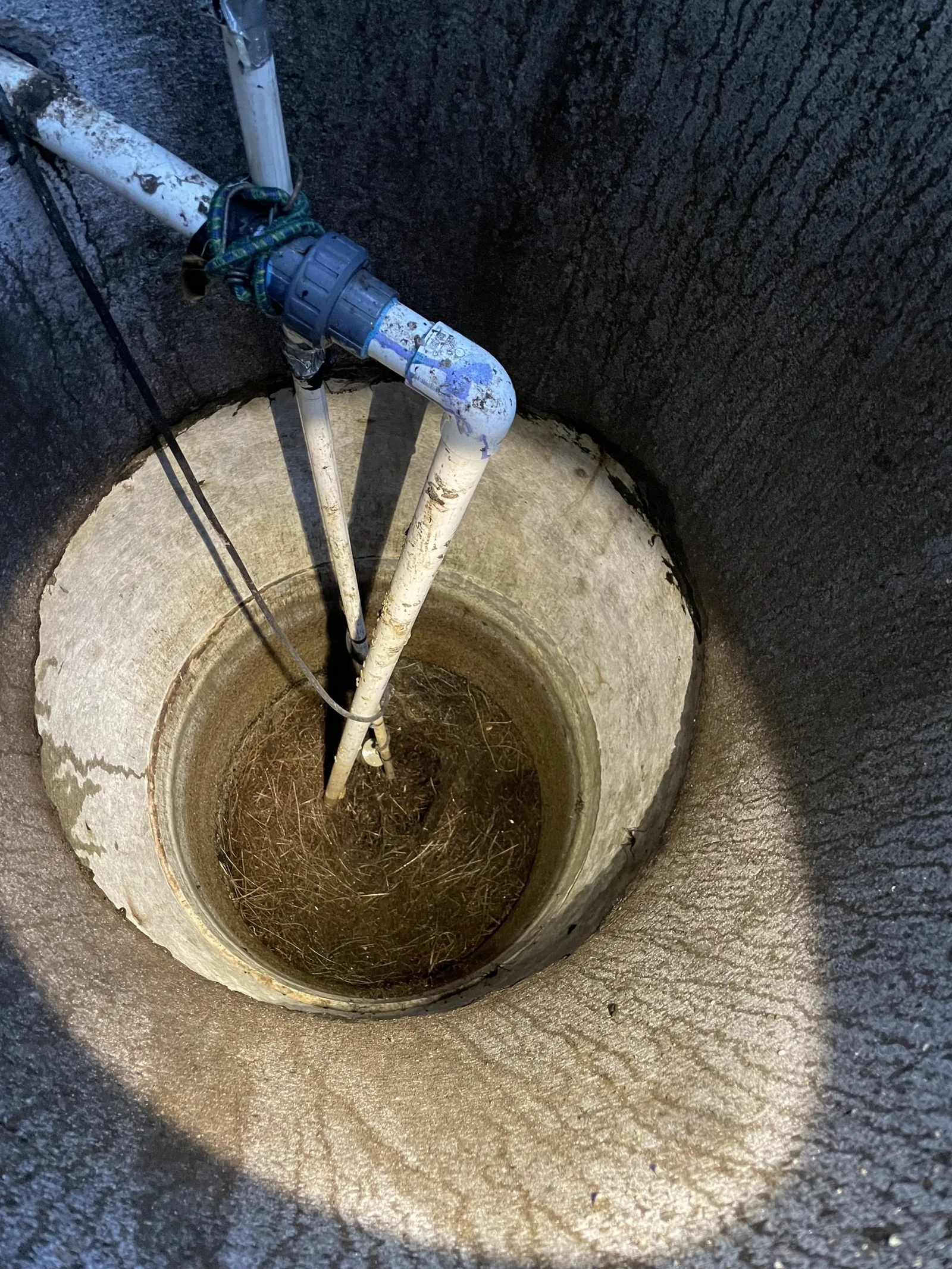
If bacteria are present, the first question is how they got in. A well cap that does not seal, a casing with a crack, or a pitless adapter that has lost its O-ring all give surface water a path down the annulus. Shock chlorination kills what is in the well today; without fixing the entry point, the problem returns.
We check the well head and casing as part of any bacteria investigation, and we will tell you when the well itself needs work before treatment makes sense.
UV sterilisation
Ultraviolet light inactivates bacteria, viruses and other organisms as water passes the lamp. It works only on clear water — sediment and iron shield organisms from the light — so UV is always the last stage after filtration. The lamp needs annual replacement and the sleeve needs cleaning.
Nitrate, arsenic and dissolved contaminants
These need media-based treatment or reverse osmosis. Nitrate is typically removed by anion exchange; arsenic by adsorptive media or RO depending on the species. Whole-house treatment for these is expensive, so point-of-use at the kitchen tap is often the sensible design.
How the job runs
-
01
Lab test
A certified laboratory test for bacteria, nitrate, arsenic or whatever the concern is.
-
02
Source check
Well cap, casing, pitless adapter and grout seal inspected where bacteria are involved.
-
03
Design and install
Treatment matched to the contaminant, with UV placed last and filtration ahead of it.
-
04
Verify
A follow-up sample after installation to confirm the treatment is working.
What you get
- Treatment matched to the measured contaminant, not a generic purifier
- Well head and casing inspected when bacteria are present
- UV correctly placed after filtration so it actually works
- Follow-up testing to confirm the result
Does a water softener purify well water?
No. A softener removes hardness minerals. It does not remove bacteria, nitrate or arsenic, and it should never be treated as a purification step.
Does boiling well water remove nitrate?
No — boiling concentrates nitrate because the water evaporates and the mineral stays behind. Use a treatment system designed for nitrate or an alternative water source.
How often should a UV lamp be replaced?
Annually. The lamp continues to produce visible light long after the UV output has fallen below the level needed to disinfect. The quartz sleeve should be cleaned at the same time.
Can I treat bacteria with chlorine alone?
Shock chlorination disinfects the well and plumbing at that moment. If the well head or casing is letting surface water in, bacteria return. The durable fix is sealing the entry point, with UV as a barrier downstream.
How often should a private well be tested?
At least once a year for bacteria and nitrate, and every few years for arsenic and other minerals. Test after any flooding, any work on the well, and any change in taste, smell or colour.
Related services
Well water testing
Sampling and interpretation for bacteria, nitrate, arsenic, iron, manganese, hardness and pH.
Read moreWell water filtration
Whole-house filtration designed from a water test — sediment, iron, manganese, sulphur and taste, not a generic cartridge.
Read moreWater softening
Removing the calcium and magnesium that scale heaters, spot glassware and shorten appliance life.
Read moreWell water purification across the service area
This service is available throughout Lane, Linn, Benton and Douglas counties. These pages cover the towns we are called to most.
Talk to a well tech
Not sure whether it is the pump, the tank or the well?
That is what the phone is for. Describe what the water is doing and we will tell you what it sounds like.
Request service
Book well water purification
Send the details and we will call back with a time. If the water is off now, call 541-935-7867 instead.
Phone
Based in
22071 Fisk Rd
Noti, OR 97461
Emergency
No water, a burst line or a pump that will not stop: call any hour, including weekends.