Service 09
Water Line Repair & Leak Detection
Finding and repairing leaks between the well, the pressure tank and the house — without digging up more yard than necessary.
The short answer
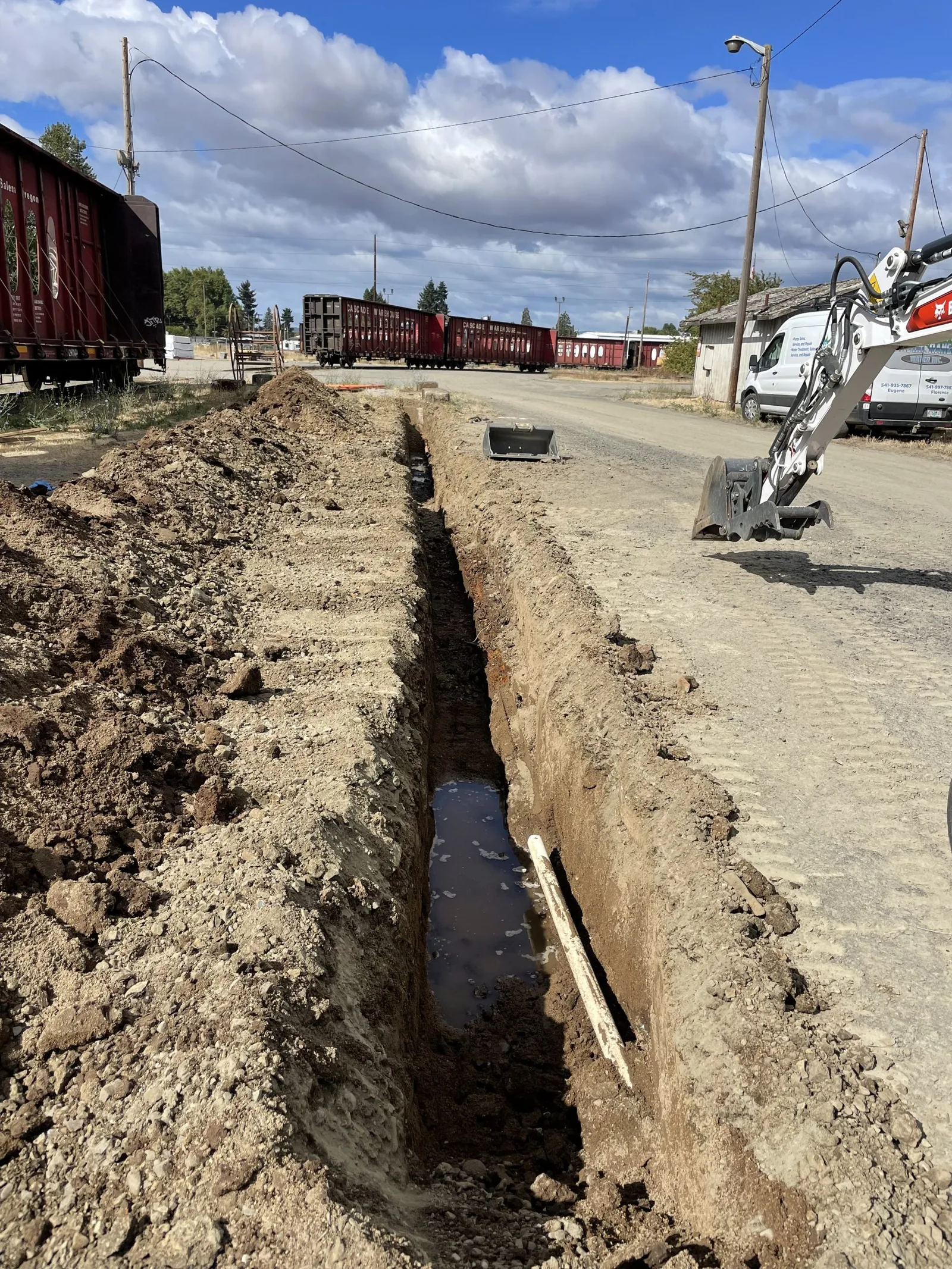
Water line repair covers the pipe between the well head and the house, the fittings at the pressure tank, and any exterior run to a shop, barn or irrigation system. The usual failures are freeze damage, root intrusion, failed poly fittings, corrosion at older galvanised joints, and vibration wear where a line passes through a foundation. The first job is locating the leak, not digging.
What usually causes it
The pump runs when no water is being used
A system that will not hold pressure with every fixture closed is losing water somewhere. It might be a check valve, but on an older system it is often a buried line. A pressure-hold test tells you whether the loss is on the well side or the house side.
A wet patch, a sinkhole, or a sudden green stripe
Water surfacing in the yard, a soft spot in the gravel, or a strip of unusually lush grass over the line are all classic leak signatures. Left alone, a small leak washes out the bedding and becomes a collapsed line.
Frozen and split lines after a cold snap
Exposed risers, uninsulated crawlspace runs and shallow exterior lines split when Lane County gets a hard freeze. We repair the split and, where it makes sense, re-route or insulate so it does not happen again next year.
Signs it is time to call
Any one of these is worth a phone call. Two or more together usually means something is already failing.
- Pump runs with all fixtures closed
- Pressure will not hold overnight
- Wet or sunken ground along the line
- Water bill or pump run-time rising with no change in use
- Air sputtering at taps after the system sits
- Visible corrosion or seepage at the tank fittings
- Line damage after excavation or landscaping
Locating before digging
We isolate sections of the system with valves and watch pressure to work out which side of the tank is losing water. From there, a line locate or a careful trace along the run narrows the position. Digging a 60-foot trench to find a leak is expensive and unnecessary when the leak can be isolated to a ten-foot section.
Repair methods
For a damaged section of poly line, we cut out the failure and join with properly rated compression or barbed fittings, bedded and protected. For older galvanised or copper lines that have failed in multiple places, spot repairs become a losing game and replacement of the run is the better answer.
Where the line runs under a driveway, patio or established landscaping, a trenchless replacement avoids the destruction entirely. That is often the deciding factor for a homeowner facing a failed line under a concrete apron.
After the repair
We pressure-test the repaired section, run the pump through a full cycle and confirm the system holds pressure with everything closed. If the original cause was a shallow bury or a missing sleeve through the foundation, we fix that too so the repair lasts.
How the job runs
-
01
Isolate
Valve off sections and pressure-test to establish which side of the system is losing water.
-
02
Locate
Trace the run and narrow the leak to a diggable area before any excavation.
-
03
Repair
Cut out the failed section, rejoin with rated fittings, bed and protect the line.
-
04
Test
Pressure-hold test, full pump cycle and a check that nothing else was disturbed.
What you get
- Leak isolated before excavation, so you pay to dig once
- Repairs that address the cause — shallow bury, missing sleeve, bad fitting
- Trenchless options when the line runs under concrete or landscaping
- System pressure-tested before we leave
How do I know if my underground water line is leaking?
The clearest sign is a pump that runs when nothing is open, or a system that will not hold pressure overnight. In the yard, look for a wet patch in dry weather, a sunken area, or a strip of grass that stays green when everything else dries out.
Can you repair a water line without digging up the yard?
Often yes. Trenchless methods pull a new line through the old one or bore a new path with only two small access pits. It depends on the line material, the length, and whether there are sharp bends. We will tell you which method fits your run.
Who is responsible for the water line on my property?
On a private well, the entire line from the well head to the house is the property owner's responsibility. On a municipal supply, the utility is usually responsible up to the meter and the owner from the meter onward. On a shared well, the line and its maintenance are governed by whatever agreement exists between the users.
How deep should a water line be buried in Oregon?
Deep enough to stay below the frost line for your elevation — commonly 18 to 24 inches in the valley, deeper in the foothills and east of the Cascades. Many older rural lines are shallower than they should be, which is why they split in a hard freeze.
Related services
Trenchless water lines
Replacing a failed water service under lawns, driveways and landscaping with two small access pits instead of a trench.
Read moreWell pump repair
Diagnosis and repair for submersible, jet and booster pumps that have stopped, slowed down or started short-cycling.
Read moreLow water pressure
Tracking down whether the pressure loss is the tank, the switch, a clogged filter, the pump, or the well itself.
Read moreWater line repair across the service area
This service is available throughout Lane, Linn, Benton and Douglas counties. These pages cover the towns we are called to most.
Talk to a well tech
Not sure whether it is the pump, the tank or the well?
That is what the phone is for. Describe what the water is doing and we will tell you what it sounds like.
Request service
Book water line repair
Send the details and we will call back with a time. If the water is off now, call 541-935-7867 instead.
Phone
Based in
22071 Fisk Rd
Noti, OR 97461
Emergency
No water, a burst line or a pump that will not stop: call any hour, including weekends.