Service 01
Well Pump Repair in Lane, Linn, Benton & Douglas Counties
Diagnosis and repair for submersible, jet and booster pumps that have stopped, slowed down or started short-cycling.
The short answer
Well pump repair is the diagnosis and correction of a pump that has failed or is failing — a submersible pump in the well, a jet pump above ground, or a booster pump feeding a house or irrigation system. Most repairs come down to one of five things: the pump motor, the pressure switch, the pressure tank, the check valve, or the wiring and controls. Finding out which one takes measurements at the tank and at the well head before anyone pulls the pump.
What usually causes it
The pump is running but no water comes out
If the motor hums or the controller shows power, the pump is likely running dry, the impeller is worn out, or the check valve has failed and water is draining back down the drop pipe. Running a pump dry for more than a few minutes can destroy the motor, so this one should be switched off at the breaker and left off until someone tests it.
The pump short-cycles — on, off, on, off
Rapid cycling is almost always a pressure tank that has lost its air charge or a bladder that has ruptured. The pump is doing its job; the tank is no longer absorbing the pressure swing. Left alone, short cycling burns out motors and pressure switches.
The breaker trips, or the pump will not start at all
A tripped breaker points to a short in the pump cable, a failed motor winding, or a control box that has given up. Repeated resets make it worse. We check voltage and amp draw at the controller first so we know whether the problem is at the surface or down the hole.
Pressure is weak, or it drops when two taps run
A worn impeller, a partially clogged line, a failing check valve or a pump that was never sized for the house all show up this way. A flow test tells us whether the pump is underperforming or the plumbing downstream is restricting it.
Signs it is time to call
Any one of these is worth a phone call. Two or more together usually means something is already failing.
- No water at any fixture, with the breaker on
- Pump runs constantly and never reaches cut-out pressure
- Pressure gauge sits at zero even when the pump runs
- Water sputters or surges, then runs clear
- Breaker trips shortly after the pump starts
- Grinding, clicking or humming from the pressure switch
- Sediment or grit in the water after the pump starts
- Pressure good in the morning, weak by evening
What we check before pulling a pump
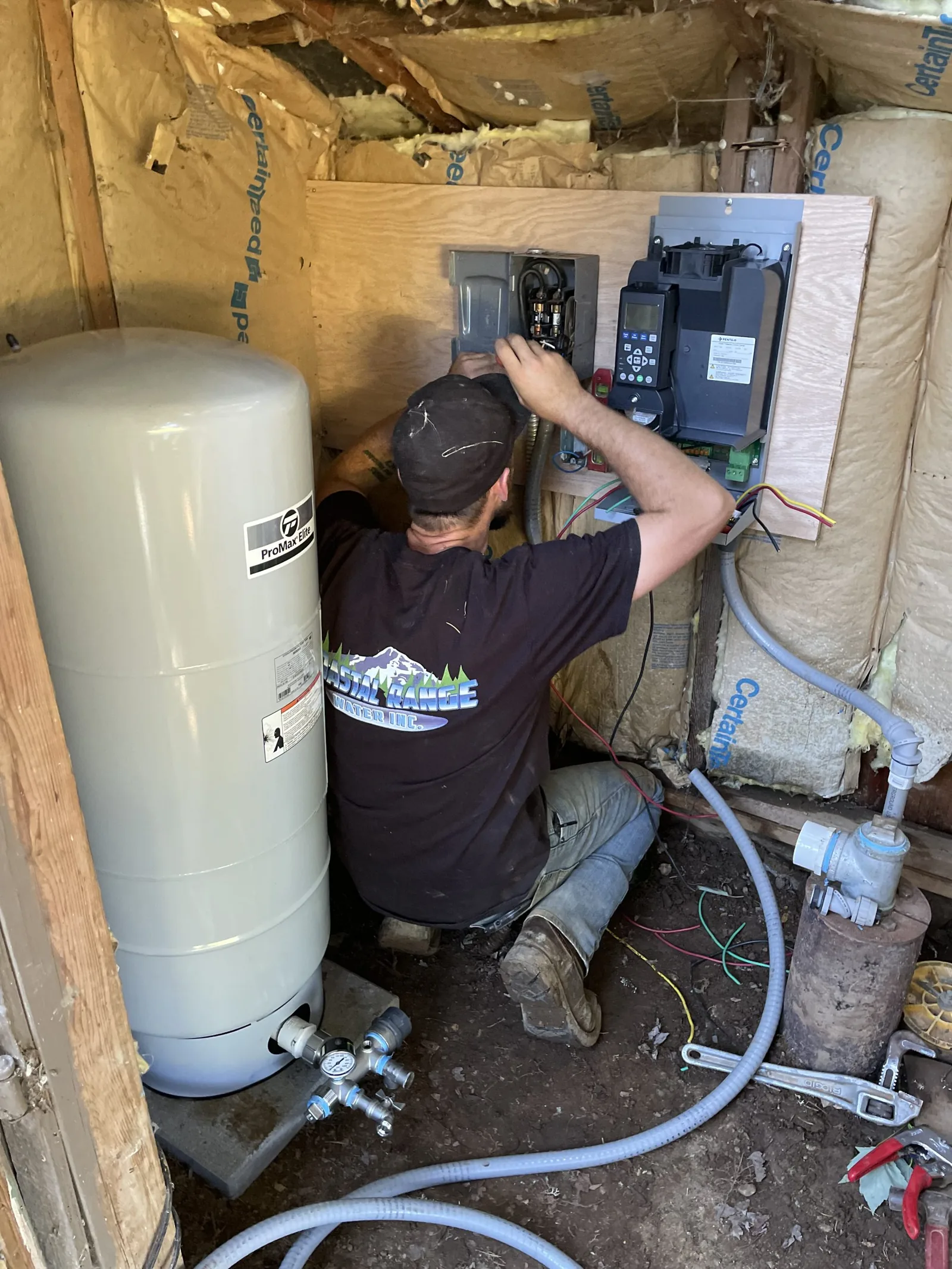
Pulling a pump is the most expensive part of most repairs, so we do everything possible at the surface first. At the pressure tank we check the switch settings, the tank pre-charge, the gauge and the breaker. At the well head we check voltage under load, amp draw against the motor nameplate, and whether the pitless adapter or the drop pipe is leaking.
If those tests point to the pump, we pull it with a hoist, inspect the motor, impeller and cable, and give you a straight answer: repair what is repairable, replace what is not. A pump that has been pulled once for a failed motor is usually not worth putting back in the hole at 15 years old.
Submersible, jet and booster pumps are different animals
A submersible pump sits below the water line and pushes water up. A jet pump sits above ground and pulls water up with suction, which limits how deep it can work. A booster pump pressurises water that already exists — from a cistern, a storage tank, or a low-pressure municipal line.
The diagnostic path is different for each. A jet pump that loses prime has an air leak on the suction side. A booster pump that hunts has a failing pressure sensor or a tank that needs air. We work on all three, plus the irrigation pumps used on the farms around Junction City and Harrisburg.
What a repair typically involves
Most repairs fall into a small number of jobs: replace the pressure switch, re-charge or replace the pressure tank, replace a check valve, repair a cable splice, replace a control box or capacitor, or pull and replace the pump itself. We carry the common parts on the truck so a single visit handles the usual failures.
If the well produces sand or grit, the pump may be sitting too high or the screen may be failing. That is a different conversation, and we will tell you plainly when a repair is treating a symptom rather than the cause.
How the job runs
-
01
Phone triage
We ask what the water is doing and whether the pump is running. That usually narrows it to the tank, the switch or the pump before we leave the shop.
-
02
On-site diagnosis
Pressure, switch settings, tank pre-charge, voltage and amp draw at the controller. You get the finding and a price before work starts.
-
03
Repair
Switch, tank, check valve, control or pump — repaired or replaced on site wherever the parts allow.
-
04
Verification
We run the system through a full cycle, confirm cut-in and cut-out pressure, check for leaks and leave the well house tidy.
What you get
- One visit for the common failures — switches, tanks, controls and pumps are on the truck
- Amp and voltage testing before anyone pulls the pump, so you do not pay for a pull you did not need
- Straight repair-or-replace advice based on the motor, the well and the age of the system
- 24-hour emergency line for no-water calls
Why is my well pump running but producing no water?
The pump is moving something, but not water into the house. The usual causes are a failed check valve letting water drain back down the drop pipe, a worn impeller that can no longer build pressure, a pump sitting above a falling water table, or a broken drop pipe. Switch it off at the breaker and have the pressure and amp draw checked — running dry will ruin the motor.
How much does well pump repair cost in Oregon?
It depends entirely on what failed. A pressure switch or a tank re-charge is a small job; pulling and replacing a submersible pump at 200 feet is a different scale of work. We give you the diagnosis price and the repair price before starting, and we do not add charges afterwards.
Can you repair a pump the same day?
For the common surface failures — switch, tank, control box, wiring — usually yes. If the pump has to be pulled, it depends on the hoist schedule and whether the replacement matches what is in the well. Call and we will tell you honestly what the day looks like.
Is it worth repairing an old pump?
If the pump is under about ten years old and the motor tests healthy, repair usually makes sense. If it has already been pulled once, the motor is drawing high amps, or the well has sand problems, replacement is usually the cheaper path over the next few years.
Do you repair jet pumps as well as submersible pumps?
Yes. Jet pumps, shallow-well pumps, convertible jet pumps, booster pumps and the irrigation pumps used on farms around the valley are all part of the work.
Related services
Well pump replacement
Pulling an ageing or failed pump and setting a new one, with the well, the drop pipe and the controls inspected while it is open.
Read morePressure tank repair
Testing pre-charge, replacing failed bladders and sizing a new tank so the pump stops short-cycling.
Read morePump diagnostics
Pressure, amperage, flow and drawdown testing to find the actual fault instead of replacing parts by guesswork.
Read moreWell pump repair across the service area
This service is available throughout Lane, Linn, Benton and Douglas counties. These pages cover the towns we are called to most.
Talk to a well tech
Not sure whether it is the pump, the tank or the well?
That is what the phone is for. Describe what the water is doing and we will tell you what it sounds like.
Request service
Book well pump repair
Send the details and we will call back with a time. If the water is off now, call 541-935-7867 instead.
Phone
Based in
22071 Fisk Rd
Noti, OR 97461
Emergency
No water, a burst line or a pump that will not stop: call any hour, including weekends.