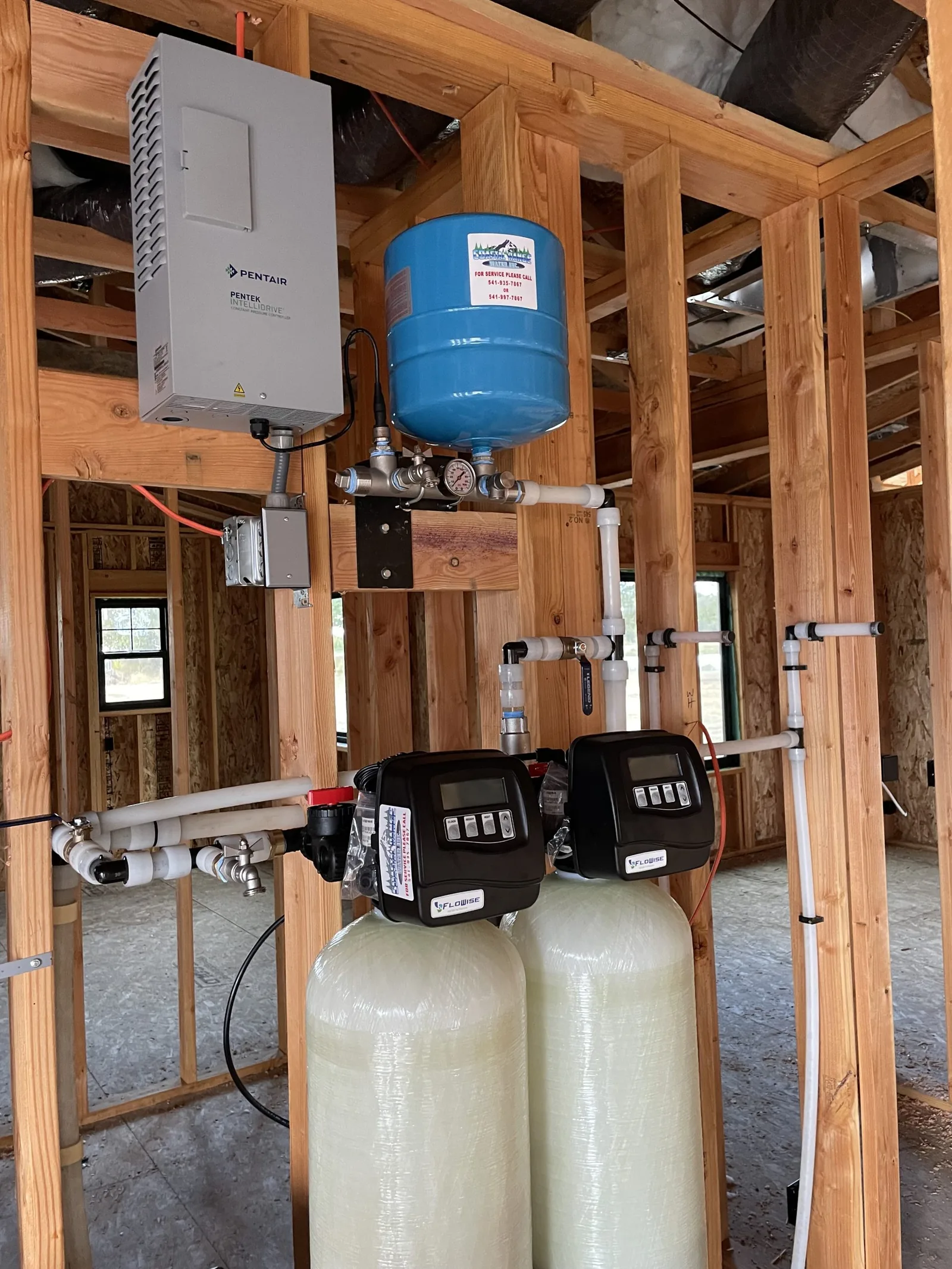
System
Water Pump Systems
Complete systems — pump, drop pipe, pressure tank, controls and storage — designed as one machine rather than a set of parts.
The short answer
A water pump system is the whole arrangement that gets water from the well to the tap: the pump and motor, the drop pipe and check valve, the pitless adapter, the pressure tank, the pressure switch or variable-frequency drive, and the plumbing into the house. Each part has to suit the others. A perfectly good pump on an undersized tank will short-cycle itself to death, and an oversized tank on a low-yield well will not solve the supply problem.
What usually causes it
A system assembled from whatever was on the truck
Mismatched components are the most common reason a well system performs poorly. A 10-gallon tank on a 15-gallon-per-minute pump cycles constantly; a 1.5 hp pump on a 3-gallon-per-minute well runs dry every summer.
No room for storage
Low-yield wells need a storage tank and a booster pump so the well can recover while the house draws water at its own rate. Without storage, every high-demand fixture fights the well.
Controls that nobody can explain
Pressure switches, relays, capacitors and drives fail. A system with labelled controls and a written record of its settings is far easier to diagnose than a tangle of unmarked wire.
Signs it is time to call
Any one of these is worth a phone call. Two or more together usually means something is already failing.
- System never worked well since installation
- Pressure drops when more than one fixture runs
- Pump cycles constantly
- Well runs dry in summer
- No storage on a low-yield well
- Controls tripping or overheating
Designing around the well, not the catalogue
We start with the well log and a drawdown test, then work out the household peak demand. From there the pump curve, tank size, pipe diameter and control strategy follow. Where the well is marginal, we design in storage rather than fitting a bigger pump and hoping.
What we install
Submersible pump systems for drilled wells, jet pump systems for shallow wells and cisterns, booster systems for storage tanks and low-pressure supplies, and constant-pressure systems where the house benefits from steady pressure.
- Submersible pump, drop pipe, cable and pitless adapter
- Bladder pressure tank sized to the pump flow
- Pressure switch or variable-frequency drive
- Storage tank and booster pump for low-yield wells
- Isolation valves, drains and a labelled control panel
How the job runs
-
01
Assess the well
Depth, static level, yield and drawdown, plus the condition of the casing and pitless adapter.
-
02
Design
Pump, tank, controls and storage specified as a matched set with a written scope.
-
03
Install
Set the pump, plumb the pressure system, wire and label the controls.
-
04
Commission
Flow and pressure test, settings recorded, and a walkthrough of the system.
What you get
- Components specified as a matched system
- Storage designed in for low-yield wells
- Labelled controls and recorded settings
- One contractor accountable for the whole installation
What is included in a well water pump system?
The pump and motor, the drop pipe and check valve, the pitless adapter through the casing, the pressure tank, the pressure switch or drive, the wiring and the plumbing into the house. On low-yield wells it also includes a storage tank and booster pump.
How much does a new well pump system cost?
It depends on depth, horsepower, tank size and whether storage is needed. We quote the whole system after assessing the well rather than pricing parts in isolation.
Do I need a storage tank?
If the well produces less than the house can draw at peak — typically under five gallons a minute — storage makes the system far more livable. The well fills the tank slowly; the booster serves the house at full pressure.
Can you upgrade part of an existing system?
Often yes. Replacing a failed tank or an obsolete control while keeping a healthy pump is common. We will tell you when a partial upgrade is false economy.
Related services
Well pump installation
New submersible, jet and booster pump installation sized to the well yield, the depth and what the house actually uses.
Read morePressure tank repair
Testing pre-charge, replacing failed bladders and sizing a new tank so the pump stops short-cycling.
Read morePump diagnostics
Pressure, amperage, flow and drawdown testing to find the actual fault instead of replacing parts by guesswork.
Read moreWater pump systems across the service area
This service is available throughout Lane, Linn, Benton and Douglas counties. These pages cover the towns we are called to most.
Talk to a well tech
Not sure whether it is the pump, the tank or the well?
That is what the phone is for. Describe what the water is doing and we will tell you what it sounds like.
Request service
Book water pump systems
Send the details and we will call back with a time. If the water is off now, call 541-935-7867 instead.
Phone
Based in
22071 Fisk Rd
Noti, OR 97461
Emergency
No water, a burst line or a pump that will not stop: call any hour, including weekends.