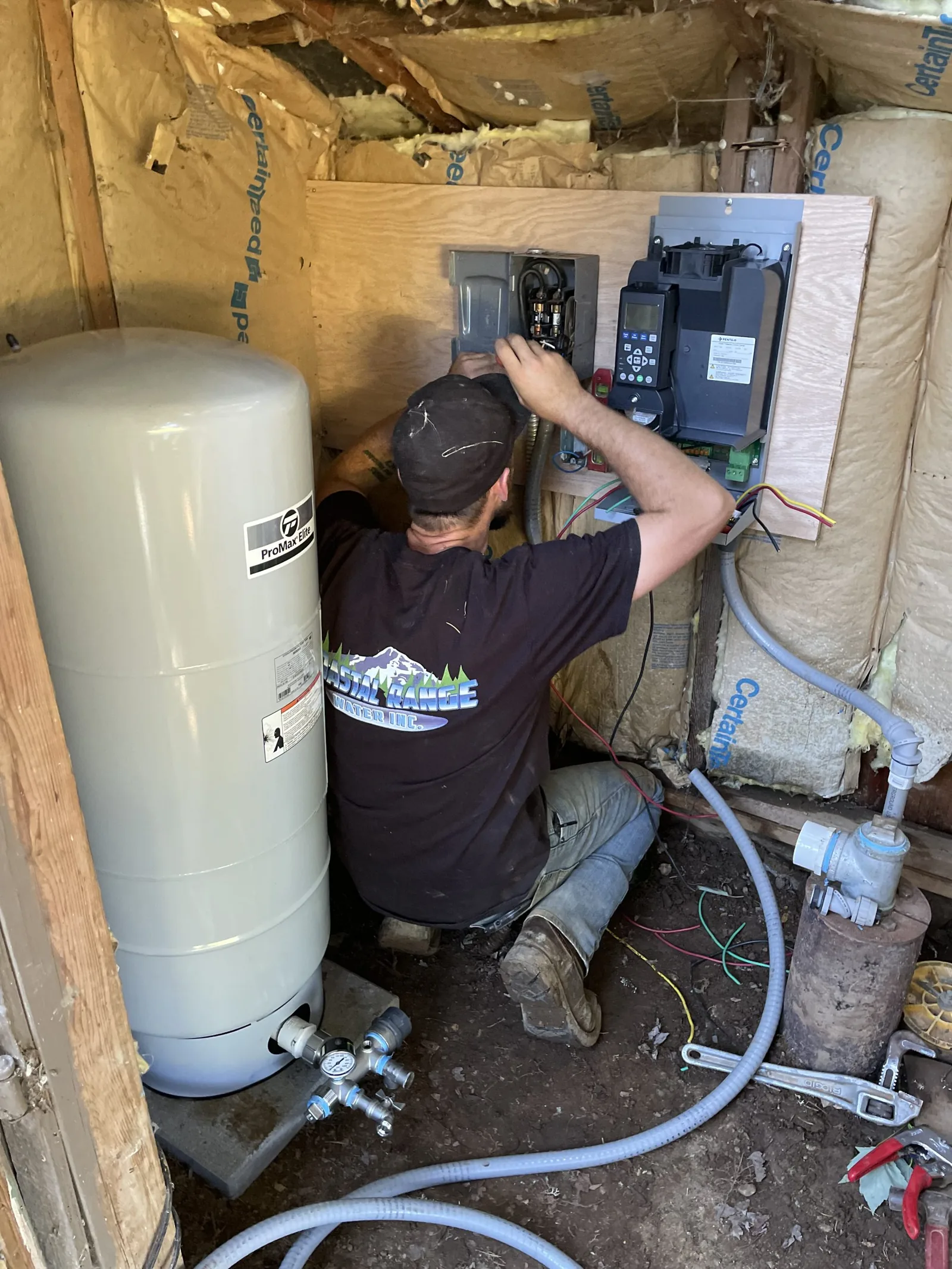
Pressure changes throughout the house
A pressure gauge that swings sharply while you use a faucet can point to a pump, pressure tank, or switch problem. You may notice a shower that starts strong, fades, and recovers, or a washing machine that fills in uneven bursts. A new pattern affecting every fixture deserves attention, even when water still flows.
First check whether only one faucet is weak. A clogged aerator or fixture can mimic a pump problem, while whole-house fluctuation points farther upstream. Note the gauge reading and when the pump starts or stops. Do not adjust the pressure switch yourself; arrange a water-pump diagnostic instead.
The pump runs constantly
A healthy system cycles as water is used and the pressure tank refills. Continuous running means the system may be unable to reach its cut-off pressure. A leak, clogged filter, low well yield, failed pump, or control problem can produce the same symptom, so the sound alone cannot identify the repair.
Turn off unnecessary water use and listen for the pump. If it continues running, switch it off at the breaker to prevent overheating. Do not keep resetting a tripped breaker. A technician can test flow, pressure, electrical components, and the well system together.
Unusual noises or rapid cycling
Clicking, humming, grinding, or repeated starts are useful warnings. A pressure tank that has lost its air charge may make the pump cycle every few seconds, while a motor or wiring fault may sound different. Sudden noise after an outage, storm, or plumbing repair should be reported even if the taps still work.
Rapid cycling stresses the motor and controls. Avoid opening the pressure-switch cover or touching wiring. Record the sound, frequency, gauge movement, and whether the symptom changes when several fixtures run. These observations help a professional plan a safe inspection without treating a symptom as a remote diagnosis.
Cloudy, rusty, or sandy water
A change in appearance can occur when a pump disturbs sediment, the water level drops, or a screen, casing, or household pipe has a problem. Rust-colored water may come from plumbing rather than the pump. Persistent discoloration at every fixture, especially alongside pressure trouble, calls for investigation rather than simply adding a filter.
Do not drink water after flooding, a damaged wellhead, or another event that could introduce contamination until it has been tested. Use bottled water for drinking and cooking when safety is uncertain. A pump inspection and well-water testing may both be appropriate; tell the technician when the change began.
Air sputters from faucets
Spitting faucets, toilet tanks that refill noisily, or bursts of air in a shower can mean the pump is drawing air, the well level is low, or a fitting is allowing air into the line. A pressure tank problem can also make flow feel uneven. The symptom is more concerning when it appears at several fixtures at once.
Watch for a relationship with heavy household use or a dry spell, but do not assume seasonal demand is the only explanation. Keep records of water appearance, pressure, and pump cycling. If the system loses prime or stops delivering water, turn off the breaker and request service rather than repeatedly restarting it.
Breaker trips or controls get hot
A breaker that trips can reflect an electrical fault, locked motor, damaged cable, failing control box, or another condition that needs testing. Warm or scorched control components are not normal. A single trip should not be ignored if it returns, particularly when it happens as the pump starts.
Switch the pump off at the breaker and leave it off if the breaker trips again, smoke or burning odor is present, or water has reached electrical equipment. Keep clear of exposed wiring and do not remove covers. A qualified professional should test the circuit and pump before power is restored.
When to call before water stops
Call promptly when several warning signs appear together, pressure is declining, the pump runs without stopping, or the system has no water after a power event. Early inspection may distinguish a serviceable control or tank issue from a pump that is near the end of its working life. Waiting can turn a small fault into a no-water emergency.
Coastal Range Water Inc. serves Lane, Linn, Benton, and Douglas counties from Noti. For service, call 541-935-7867; emergency help is available 24 hours. A technician can explain the findings and options without promising a repair until the well, pump, controls, and pressure system have been checked.
Questions about this
How long does a well pump last?
Service life varies with pump type, water conditions, use, installation quality, and maintenance. A pump that is cycling rapidly or losing pressure may need attention sooner than its age suggests. Have the complete system tested before deciding whether age alone justifies replacement.
Can I reset my well-pump breaker?
You can check that the breaker is fully off and on once if there is no sign of damage, but do not keep resetting it when it trips again. Repeated trips can indicate an electrical or motor fault. Leave the pump off and arrange professional testing if the problem returns.
Why does my pump run but produce no water?
Possible causes include a low water level, loss of prime, a blocked intake, a broken line, a failed pump, or an electrical problem. These symptoms cannot be diagnosed safely from a distance. Turn the pump off if it runs continuously and have the system inspected.
Should I test my well water after pump trouble?
Testing is sensible when water changes color, floods have affected the wellhead, repairs disturb the system, or contamination is possible. Do not drink water after flooding until it has been tested. A pump inspection identifies mechanical issues, while laboratory testing addresses water safety.
Related services
Well pump repair
Diagnosis and repair for submersible, jet and booster pumps that have stopped, slowed down or started short-cycling.
Read morePump diagnostics
Pressure, amperage, flow and drawdown testing to find the actual fault instead of replacing parts by guesswork.
Read moreEmergency pump repair
Around-the-clock response for no-water calls, burst lines, failed pressure tanks and pumps that will not shut off.
Read more